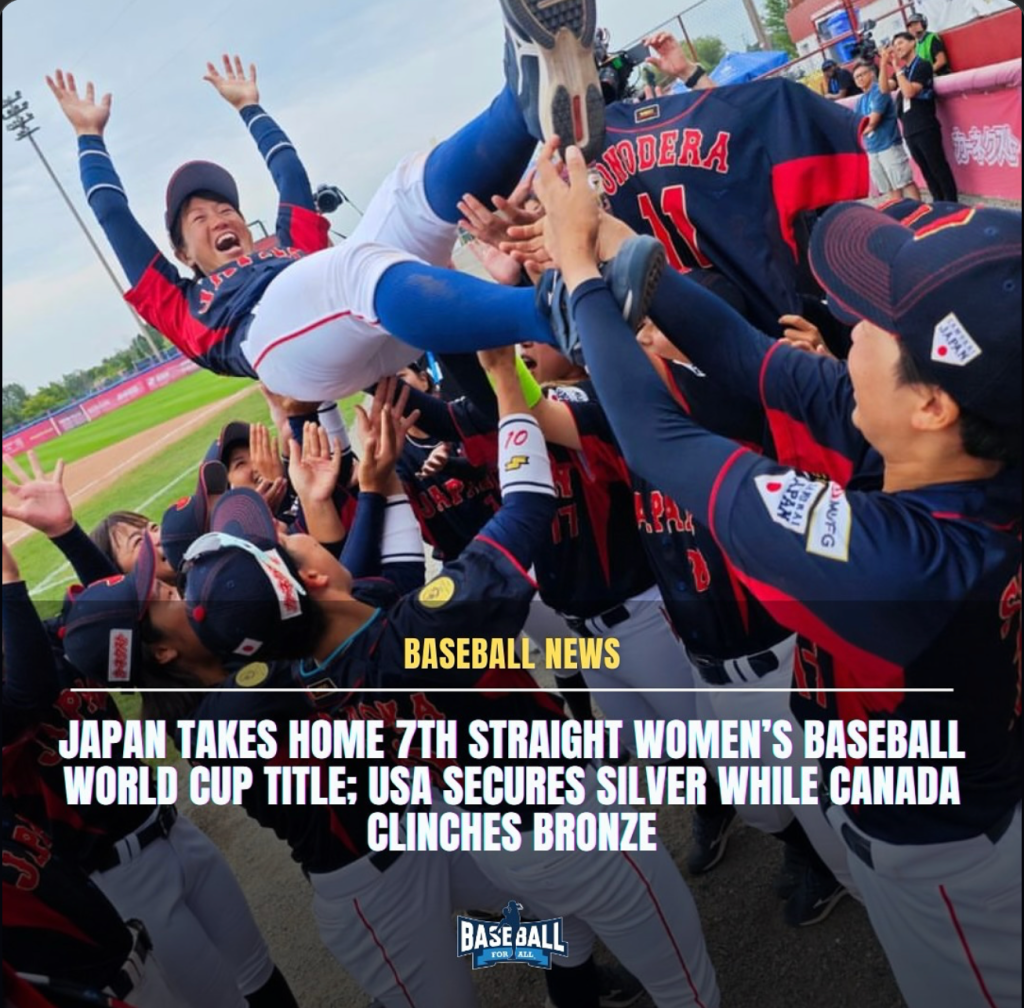
Today, I want to take a break from health-related topics and write about Baseball. It is Women’s Baseball.
My daughter started playing baseball at the age of five and, now at sixteen, is the only girl on her high school baseball team, where she plays as a regular starter.
Because of this, I have remained involved in women’s baseball. In the United States, women’s baseball is not as developed as it is in Japan, and many girls have to switch to softball when they reach high school at fourteen. Even if they want to continue playing baseball, they are often turned away by the coaches. It’s shocking that in America, which is supposed to be at the forefront of gender equality, women’s baseball is so far behind. So World Cup exists for Woman’s baseball is really a great thing.

Last week, the Women’s Baseball World Cup was held in Thunder Bay, Canada. Japan defeated the United States by a wide margin in the championship game, securing their seventh consecutive title. It was truly an extraordinary achievement. The United States had been dominating, including several mercy-rule victories, until they faced Japan. I felt that this year’s American team was formidable. As expected, in the preliminary match against Japan, the United States ended Japan’s 39-game winning streak over 12 years with a 4-3 victory, thanks to a balk by the Japanese pitcher in the final moments.
However, the championship game unfolded in an unexpected manner. By the top of the fifth inning, Japan was leading 10-1, and despite the United States’ attempts to come back, Japan won decisively 11-6, clinching the gold medal.

One of the main reasons the star-studded United States could not defeat the Japanese team is that Japan has perfected the art of “bunting.” Japan took a significant lead by repeatedly executing squeeze bunts with the bases loaded, causing the American team to make errors and allowing Japan to score four runs in succession.
Why doesn’t the United States use bunts? Why is Japan so proficient at bunting?
In Japanese, a bunt is called “犠打” (sacrifice hit). As the term suggests, it’s a strategy where one sacrifices themselves to secure a run. In Japan, if the leadoff hitter gets on first base, they will almost always bunt to advance the runner to second base, aiming to score steadily. In American professional baseball, such a tactic is never used. Even though the American team knew Japan would use bunts, they struggled to counter them.
I think the absence of bunting in American baseball stems from a cultural perspective where “sacrifice” is not considered a virtue. It may be tied to a culture that respects individuality.
In America, if you remain silent, you will be trampled upon. Many people seem to live with this subconscious mindset. The culture of “ME, ME, ME” is prevalent. This has both positive and negative aspects and is not about good or bad. It is normal for individuals to be unique and assert themselves, even at the expense of others. Compared to the United States, I believe Japan has an almost nonexistent sense of “self.”
Former MLB player Ichiro once mentioned that he never felt a sense of unity within a team in America in the season opening, except when he played for the Japanese team in the World Baseball Classic (WBC).

Interestingly, both the Japanese and American managers in this year’s Women’s Baseball World Cup emphasized the importance of “The we over the me” in the championship game. However, the starting point for this idea is fundamentally different between the two countries.
In Japan, where self-sacrifice has long been considered beautiful—be it seppuku for one’s lord or kamikaze for the emperor—it’s natural to bunt for the team without feeling any pain, itch, or regret. It is just a splendid thing.
This lack of “self” manifests in baseball as the strategic use of bunts. Japan has elevated this strategy to an art form, and as long as someone else master this art, I believe Japan will continue to win the Gold.
Subscribe to “Live Your Best”, your go-to source for comprehensive information to guide you on the path to a healthier life. Drawing from my expertise as a certified Health Coach and insights from practices such as Shiatsu, Taichi-Chen, and Daoism, I will share my discoveries for health and longevity in unconventional ways.
 LIVE YOUR BEST